
Headset — Arctis Nova Pro Wireless
Full control of the base station over USB — no root, no SteelSeries GG. Inari speaks the vendor HID protocol on /dev/hidraw directly. The tab shows a friendly "not connected" state when the headset is absent.
Supported base stations (USB product ids): 1038:12e0, 12e5, 225d — the Nova Pro Wireless and the Xbox "X" variants.
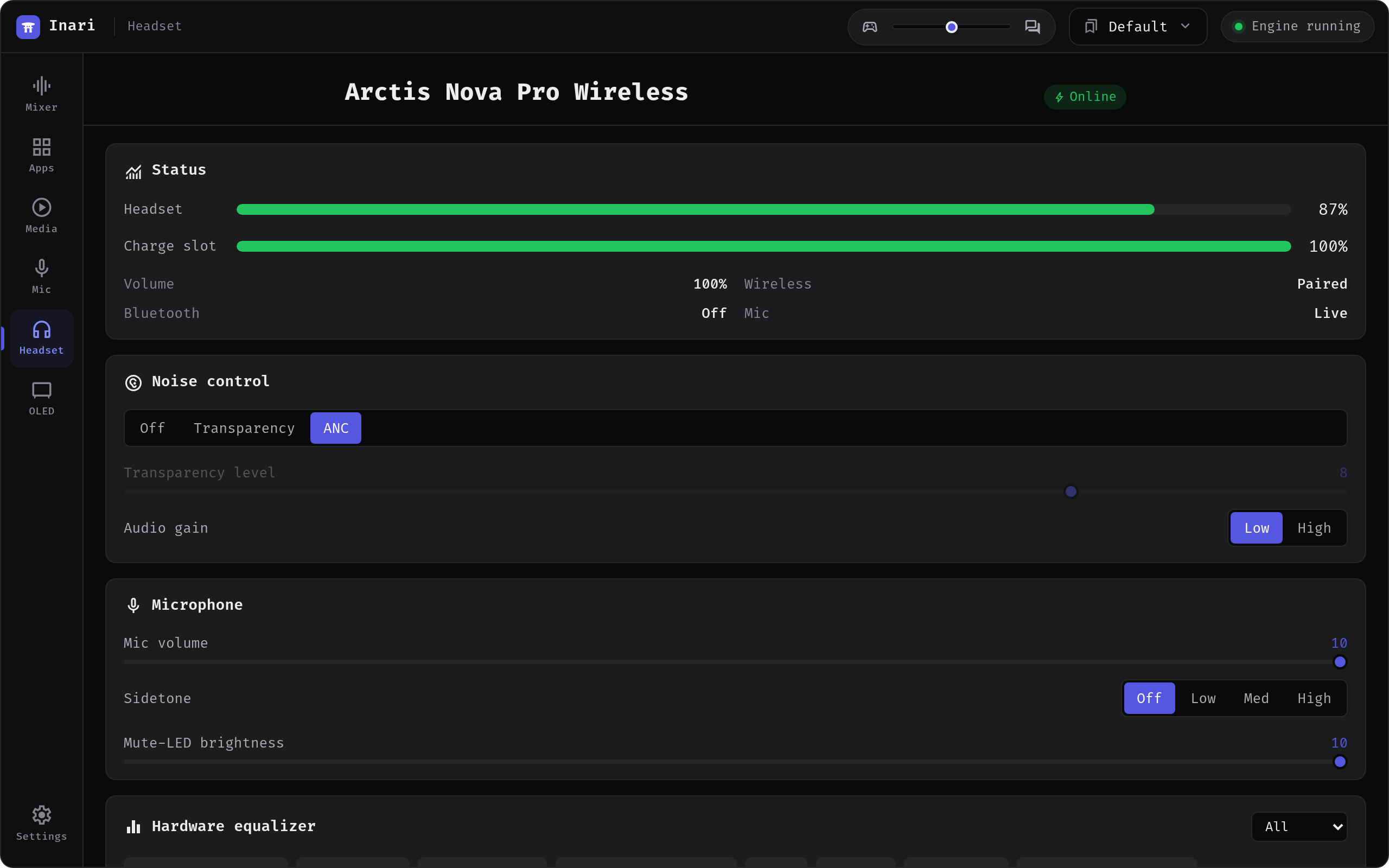
What you can control
Live status — headset and charge-slot battery, output volume, wireless pairing, Bluetooth, mic mute, power/charging state. Pushed live from the device's own event stream, plus a 2-second heartbeat.
Noise control — Off / Transparency (with passthrough level) / ANC.
Audio gain — Low / High, showing what the station is actually set to. (Before v1.0.13 the control was hard-wired to "Low", so clicking "Low" to toggle actually undid the change.)
Anti-crackle headroom — an optional WirePlumber fragment for setups that crackle. WirePlumber only reads it at startup, so it applies at next login (see Troubleshooting).
Microphone — mic volume, sidetone (Off/Low/Med/High), mute-LED brightness.
Hardware equalizer — the 10-band EQ baked into the headset, ±10 dB per band (the device stores it in 0.5 dB steps), plus its built-in presets and a large preset library, grouped by category. This is separate from Inari's per-channel software EQ.
The faders start from the curve the station already holds and show their value in dB against a 0 dB line. Before v1.0.13 they started at ten zeros, which meant the first fader you touched wrote a flat curve over whatever the station was playing — and followed it with a save to the headset's flash.
Line out — Speaker / Stream mode, with the stream mix: main, aux and microphone shares. The station stores these in steps of 5 and floors anything between, so the slider snaps to match what the device will actually keep.
Power & wireless — auto shut-off timer, 2.4 GHz Speed/Range mode.
ChatMix — the hardware wheel's game/chat balance, read live.
Changes apply immediately and are saved to the headset's own memory (debounced, so dragging a slider doesn't hammer the flash).
Notes
- Don't run another Arctis controller at the same time (SteelSeries GG under Wine,
Linux-Arctis-Manager/lam-daemon, …) — two programs writing to the same base station will fight over it. - The firmware constantly repaints the base station's own UI, which is why the OLED feature runs a continuous redraw loop.
- The protocol was cross-checked against HeadsetControl, elegos/Linux-Arctis-Manager and loteran/Arctis-Sound-Manager, and verified against real hardware. OLED encoding follows JerwuQu/ggoled.
See the Protocols reference for the HID details and Supported hardware for the udev setup.